They were voiced on a solo track, one at a time, by
someone listening to nothing else. Chain was built the other way round —
for the level a band really has when forty of them are playing.
You solo a track, switch something on, and it sounds
better. Then you play the song — and the thing you improved is harder to
hear than before.
Your ears are fine. Almost every plugin is voiced and
demonstrated on one track playing alone, and a mix is never heard that way.
Solo, the louder version wins. In a mix, the track that wins is the one that
leaves room for everything else.
Chain is built around that
difference instead of ignoring it.
How it knows
Three ways it stops you fooling yourself
Every plugin claims to sound good. These are the parts you
can check.
It matches the level
HOLD CMD+B
Louder always sounds better, so the
comparison takes loudness out of it. Chain applies the inverse of its own
level change to the bypassed signal, and freezes the match the moment you
press — you hear tone, not volume.
It measures hearing
SONE · ACUM · ASPER
A peak meter answers whether
something will clip — rarely the question you have. These six answer what it
will sound like, and they move before you reach for the headphones.
It shows what changed
WHITE OUT · RED DIFFERENCE
The delayed input minus the output,
across eighty bands. Red is what Chain added or took away — and red where
you meant to touch nothing means a setting reaches too far.
Eighty bands, and loudness, sharpness, roughness and prominence read live
underneath. Running on the demo loop.
Judge it yourself
Same loudness. Now decide.
Every pair below is matched to the same loudness, so the
louder one cannot win. That is the whole argument of this plugin, applied to
its own demo.
One frequencySAT BELL · 2,5 kHz
Matched to the same loudness · figure pending
A bell saturates one
frequency and leaves the rest alone — bite exactly where the mix needs it,
without dirtying anything around it.
Measured figures follow once the final audio is in.
A whole mixBUS · MIX 3
Matched to the same loudness · figure pending
The same mix, gently
driven. Nothing dramatic happens — that is the point. At equal loudness you
are hearing tone, not level.
GuitarWIRE CRUNCH
Matched to the same loudness · figure pending
One of the three
dirty presets, deliberately the roughest of the collection. Three decibels
had to come off to make this comparison fair.
TransientsTR · NO THRESHOLD
Matched to the same loudness · figure pending
Attack and sustain,
per band, with nothing to set that decides what counts as a transient — only
how much of it you want.
Every pair is matched to the same
loudness, and the correction applied is printed above it so you can undo it.
The raw, unmatched versions sit next to them. The audio itself is still being
cut, so the players above are quiet for now.
On one channel
Five windows, or one.
WHAT IS THERE NOW
An equaliser A saturator, or two A transient shaper A limiter
A meter to check what happened
Five plugins, five
latencies, five level changes to keep straight — and still no way to hear
the whole lot against the untouched signal at the same volume.
WITH CHAIN
One window One latency, reported honestly One level, matched for you
One display showing what changed Nothing left to keep straight
You set the order of EQ, saturation and transients. The limiter always
stands last, because it is the only stage that makes a promise about the
output level.
One window
Six views. All running at once.
The bar on the right decides what you look at — never what
is switched on.
EQ
Eight bands, seven filter types,
slopes up to a brickwall, and a dynamic section on every one. Worked on the
curve, not on a row of knobs.
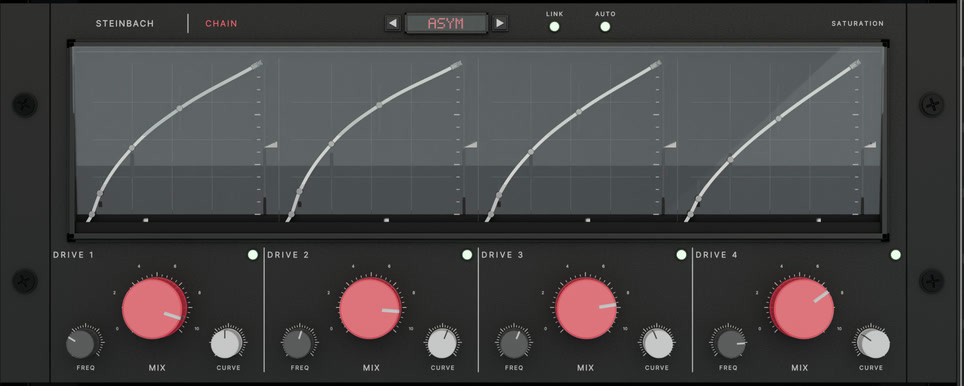
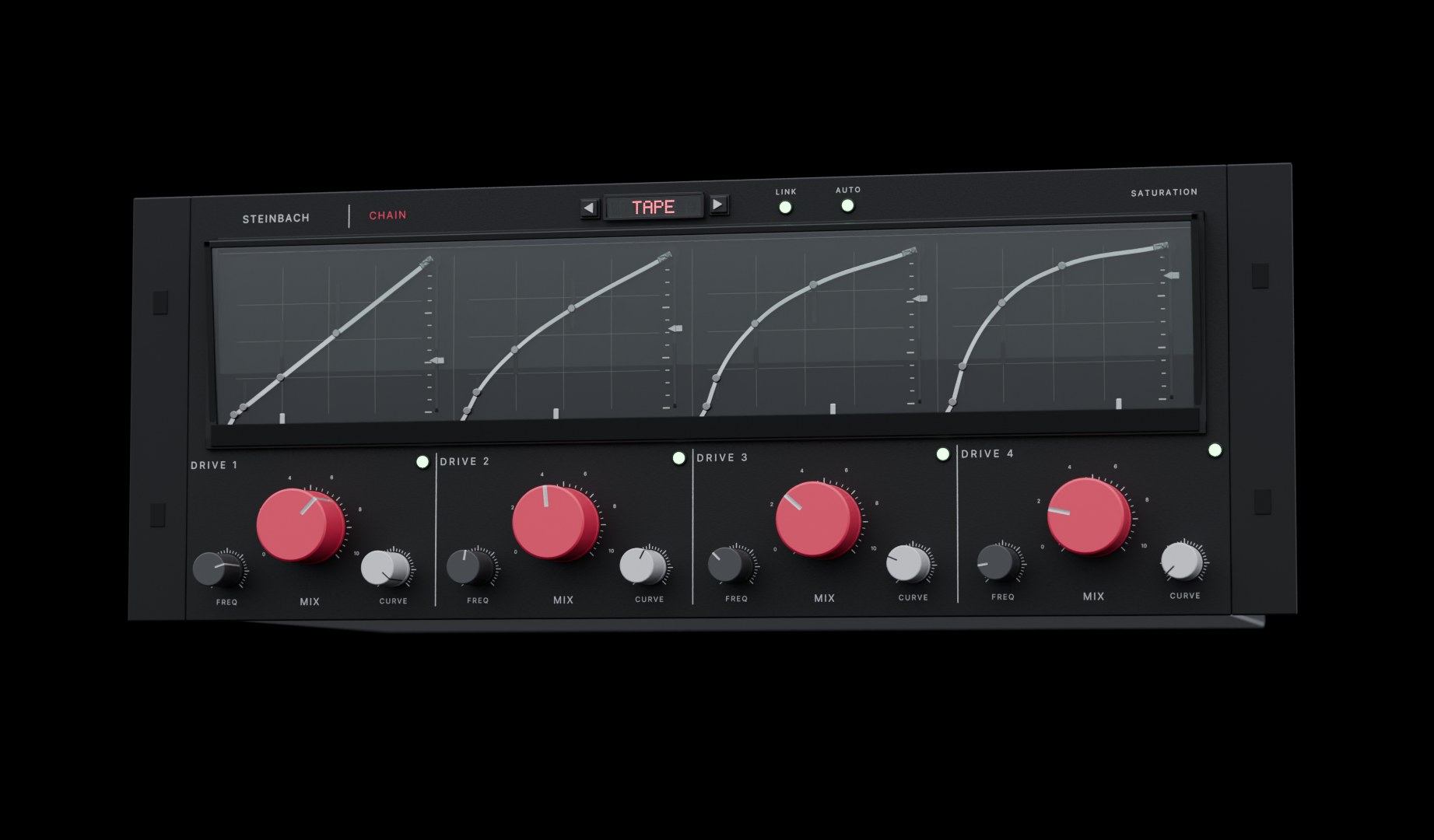
SAT
Four bands, four characters, and four
bells that saturate a single frequency and leave the rest alone.
TR
Attack and sustain per band, no
threshold to guess at, and a hundred lamellae showing where the transients
actually kick.
CLIP
A lookahead limiter and a clipper.
Safety roof or effect, and it holds the sample peak exactly.
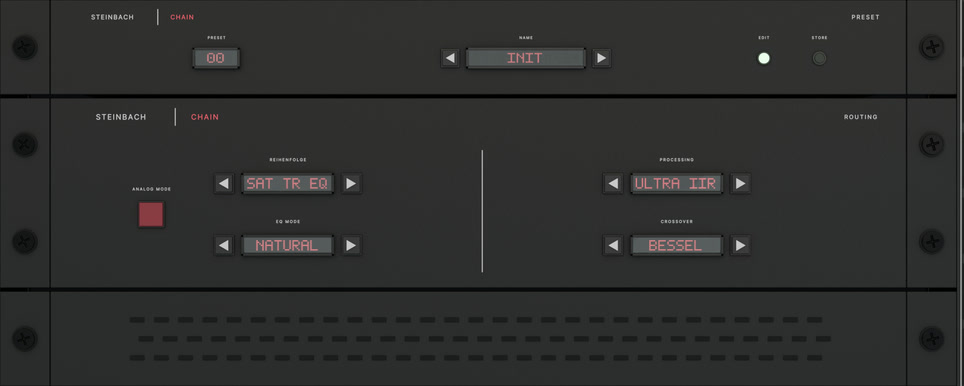
ROUT
Module order, EQ mode, crossover
type, the quality ladder, analog mode, presets.
OUT
The psychoacoustic analyser, the null
test, six measured values, and the fader.
Without the jargon
What that buys you
Matched comparison
Louder always sounds better, even when it is worse.
Chain evens out the volume when you switch.
Six measured values
A peak meter tells you if it will clip. Not whether it
will wear you out. These do.
The null test
You see what you changed. Not roughly — exactly
where.
Saturation bells
Warmth exactly where it is missing, instead of
thickening the parts that were already fine.
Voiced at −18 dBFS
Knobs that work where your music actually sits. Most
plugins do nothing over the first two thirds of their travel.
Bit transparent at zero
Off really is off — not almost. Chain can sit on the
channel and cost nothing.
Measured, not claimed
The numbers are public
Everything here is measured and printed in the manual. So
are the findings still open — we would rather you read them than discover
them.
Reference level
−18 dBFS
Where a band really sits inside a mix.
Latency, Zero Lat
2 samples
Reported honestly, not rounded to nothing.
Component sets
7
A real circuit, solved once per sample.
Analyser bands
80 ERB
On the hearing scale, not a logarithmic one.
Brickwall slope
96 dB/oct
Butterworth, sixteenth order. Corner at −3,0103 dB.
At drive zero
Bit transparent
With no drive anywhere, and no latency either.
CLAP is the native format. VST3 and AU are produced from
the same binary, so the three cannot sound different from one another.
Before you decide
The four things you are wondering
Do I really need another channel strip?
Probably not another one. This is not a better EQ
than the one you own — it is the same tools with a way to tell whether a
move helped. If you already compare level matched and read a null test, you
have most of it. If you do not, that is what this buys.
What will it cost my CPU?
With no drive anywhere the saturation stage is bit
transparent and costs no latency at all.
Analog mode solves a real circuit once per sample and is the expensive
setting: roughly a third of one core per instance, more with the wavefolder.
The quality ladder lets you choose, and the manual prints the measured
figures rather than a promise.
Will the latency fit my session?
Chain reports only latency that actually occurs, and
reports it again whenever it changes.
On the bottom rung it is two samples — and it says two rather than
rounding to zero. With the lookahead limiter on it is 81 samples at 48 kHz.
Linear phase costs 91 ms and says so.
What if it does not work for me?
Take the demo. It runs unlimited, on as many tracks
as you like, and nothing is done to the sound — no interruptions, no noise,
no bypass every few minutes. We are asking you to judge this on how it
sounds, so degrading the sound would be a strange way to begin.
The one thing it will not do is remember. Nothing is saved with your
session, which makes it useless for real work and perfect for deciding.
No VAT is charged under § 19 UStG. The licence key arrives by
email with your invoice and is entered once. It is checked on your machine,
so Chain keeps working whether or not this website does.
One payment, no subscription, no dongle, and no account to
create. The demo has no time limit. The price is the price; there are no
discount rounds to wait for.
Manual and the full measurement
report are public, including what is still open. Read them before you
decide — that is what they are for.
Steinbach Chain · 49 € · Demo unlimited, full quality